Bringing Hope to the Globe: HCHS Students’ MUN Journey
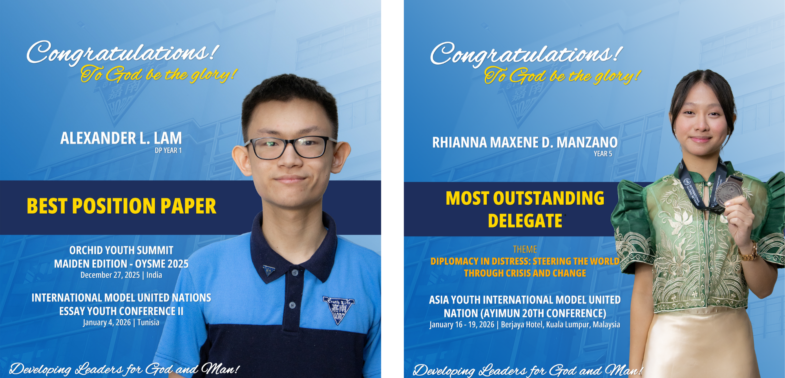
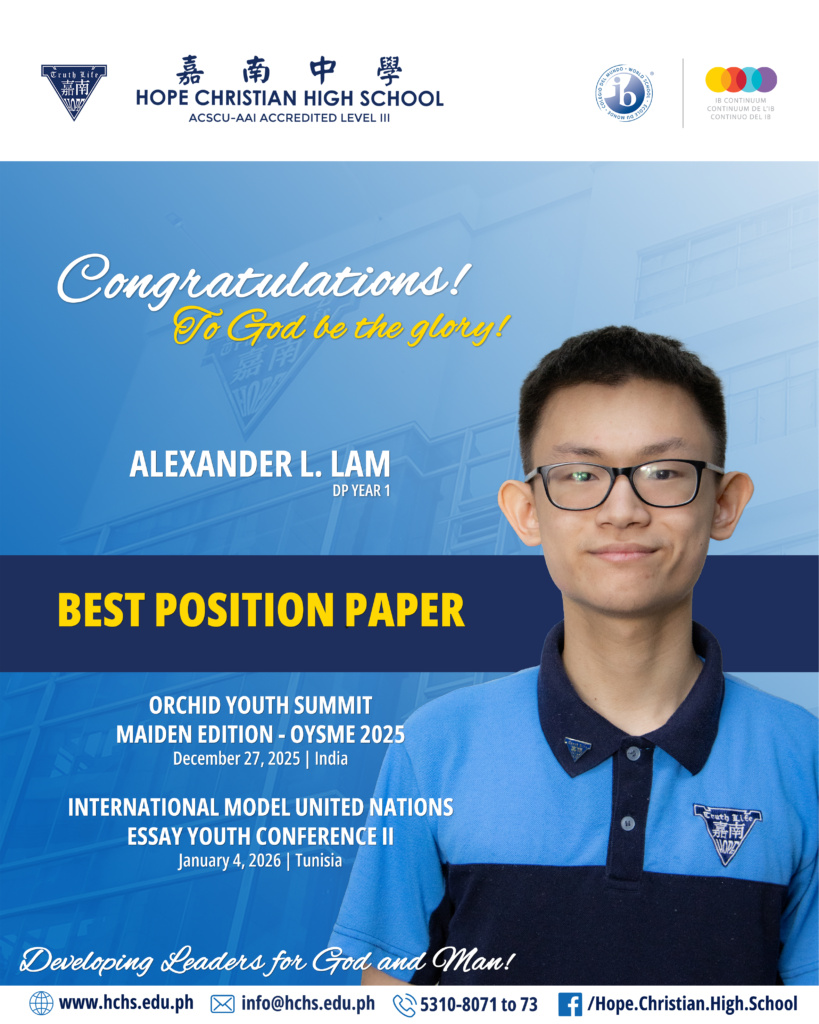
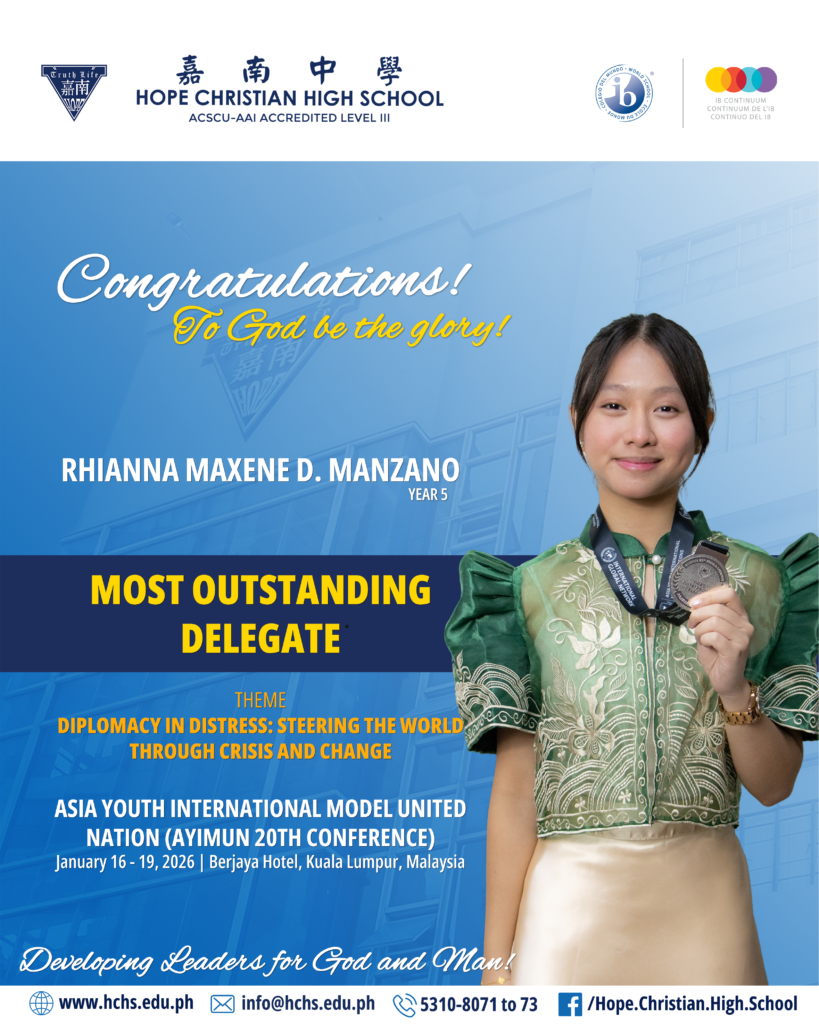
Recently, two HCHS students, Alexander L. Lam and Rhianna Maxene D. Manzano, were lauded with awards at international Model United Nations (MUN) conferences. Through their position papers and outstanding performance, they have shown that their leadership in the school can reach the world. Reflecting on this accomplishment, Alexander and Rhianna shared their insights and experiences from participating as delegates.
From revision to recognition (and beyond)
“I had to revise my position paper again due to an error I saw in my paper that could not be let go.” This last-minute yet meticulous revision earned Alexander Lam two Best Position Paper awards at the international conferences he attended.
In his position paper for the Orchid Youth Summit Maiden Edition (OYSME) 2025, Alexander represented the Republic of Korea in the World Health Organization (WHO) committee. This conference was conducted online on December 27, 2025, in India. In the WHO committee, they debated pressing issues about access to clean and safe drinking water.
For the International Model United Nations Essay Youth Conference II held online on January 4, in Tunisia, Alexander served as the delegate of the Kingdom of Denmark in the United Nations Environment Assembly (UNEA). In the UNEA, the debates underscored the importance of international cooperation and collaboration between organizations and institutions.
Behind the meticulousness and dedication shown, and accolades won, lies the longstanding spark of curiosity for diplomacy. When asked about his motivations for joining MUN conferences, Alexander shared that being an International Baccalaureate (IB) student urged him to utilize his skills and to push his boundaries. “Those skills have left an impression on me that I had to be responsible and apply what I learned,” he said. Alexander also mentioned that his Diploma Programme (DP) classes about geography, language and literature, and their interconnectedness, helped him understand the complex issues tackled in the conferences.
Beyond the recognitions he received, the countless nights of research and revisions earned Alexander more important things. His research, analytical, and communication skills were honed; he gained a better understanding of the world and its concerns.
Standing out to serve
“That moment showed me that leadership is about cooperation, not just recognition.” This mindset unironically led Rhianna Manzano, a Middle Years Programme (MYP) Year 5 student, to be recognized as the Most Outstanding Delegate in the 20th Asia Youth International Model United Nations (AYIMUN) held last January 16-19 in Kuala Lumpur, Malaysia.
Representing the People’s Republic of China in the Disarmament and International Security Committee (DISEC) Chamber 1 of the AYIMUN, Rhianna did not just engage in the debates and caucuses as a delegate but also stepped up as a leader. “I did not only focus on my own performance but also helped other delegates understand the topic better…I stepped up as a leader when negotiations became challenging,” she explained.
Aside from her award, Rhianna was also able to build connections. Among her most unforgettable experiences in the conference were drafting resolutions with her bloc over lunch and seeing them cheer for her during the recognition. “I also made many international friends who shared the same passion for diplomacy,” she said. Building such connections requires confidence and certain key skills. Through constant practice, real-time challenges posed by the MUN, Rhianna has honed her public speaking, critical thinking, and diplomacy skills. “I learned how to listen carefully and respond respectfully to opposing views. Leadership and teamwork became stronger through collaboration with other delegates,” she added.
For Rhianna, participating in MUN conferences is a step towards her goal of becoming a lawyer or a diplomat. However, her respect for diplomatic negotiations shows that it is not a mere means to an end. When invited to give a message to aspiring MUN delegates, Rhianna stressed, “They must not enter MUN just for fun or recognition, but with the intention of truly representing a country and the people it stands for.” She also noted that every speech and decision of the delegates carries a responsibility, as it reflects lives beyond themselves. Hence, for AYIMUN’s Most Outstanding Delegate, MUN is “a meaningful step toward serving the world.”
From local speech to global reach
Alexander Lam and Rhianna Manzano are not new to the intricacies of diplomacy. Prior to their international MUN recognitions, Alexander and Rhianna both served at Hope MUN (the school’s local MUN), not just as delegates but as officiating board members of the conference. In the recent Hope MUN, Alexander Lam led as the Secretary-General, while Rhianna Manzano functioned as a Board of Dais member, specifically as the Vice-Chair of the Commissions of Appointments committee.
Comparing local and international MUN conferences, Alexander and Rhianna both agree that international conferences necessitate more thorough preparation to understand global perspectives and diplomatic strategies. In terms of pressure, however, the awardees have different views. Focusing on the purpose of the conferences, Alexander regards international MUN with less pressure. “I would say international conferences have [less] pressure, as their aim is to help the future generation to improve and become future leaders of the world without holding bias or judgment,” he remarked. Alexander even admitted that joining such conferences actually helps him de-stress. On the other hand, Rhianna deems international MUN to have higher pressure. Being surrounded by fellow delegates from other countries with strong skills and experience pushed her beyond her comfort zone. The experience, nonetheless, inspired her to aim higher and to work harder not just for herself but for those around her.
Overall, the achievements of our Hope MUN leaders in international conferences prove that diplomacy can be taken both to the local and global stages. Humble discussions and speeches in four-walled classrooms should not be looked down upon nor taken for granted, for they can transcend and reach wider assembly halls. More importantly, international conferences like the MUN prove that the youth can participate in discussing global issues responsibly. With proactive young people like Alexander and Rhianna, hope for nonviolent conflict resolution can remain.